-
Nacht & Träume
Anna Júlía Fridbjörnsdóttir Nacht Anna Júlia Fridbjörnsdóttir Second solo exhibition at Gallery Gudmundsdottir Nacht presents new works that continue Anna Júlia Friöbjörnsdóttir's enquiry into materiality, form and transformation, examining how systems and language... -
Your work often explores how systems such as language, diagrams, or scientific notations become embedded in material.
What first drew you to this relationship between abstract systems and physical matter, and how does Nacht extend this enquiry?
AJF: Language and etymology play an important role in my work, but I first used Morse code as a way of abstracting language. I wanted to incorporate text in a subtle way, and I also used this mode of communication as a symbolic reference to our general need for connection.
I have always been interested in science and its history. Early on I began referencing scientific systems of classification and taxonomy in relation to specific species, astronomical positions or the measuring of time. But I am also drawn to older scientific tools, diagrams and illustrations simply for their visual beauty.
I like using information without being informative, if you like. I am not interested in being in the service of a particular message or body of knowledge, but rather in bringing together elements that create a tone or a visceral response. These elements still suggest systems or rules, although the viewer may not grasp their full meaning.
I often juxtapose opposites, both in materials and in ideas, such as natural systems and man-made ones, or order and chaos. I am also interested in translating visual elements between two and three dimensions. This relates to transformation. I am interested in the transformation of materials, but also of systems, and in the way isolated visual fragments can be perceived, though not necessarily understood, when removed from their original context.
In Nacht I wanted to bring some of these ideas into works on paper and plaster that could stand on their own or exist in a more domestic setting. Many of my previous installations have been site-specific, institutional or temporary.
-
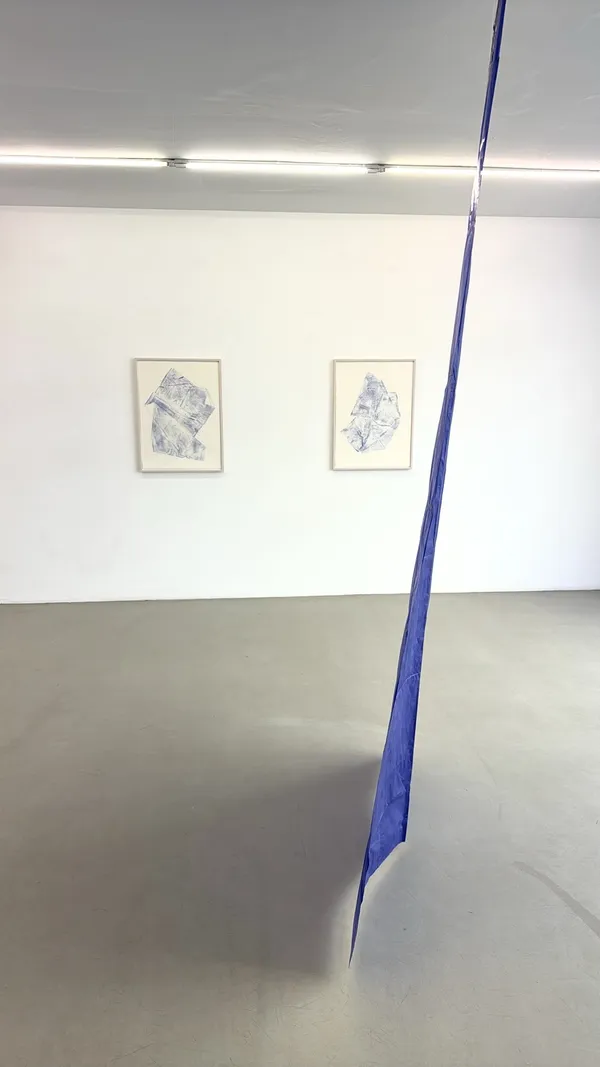
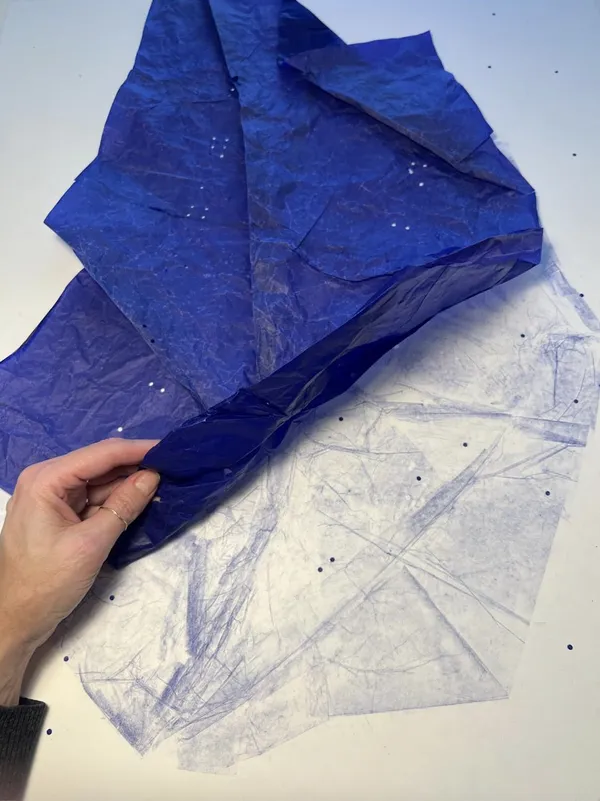
Anna Júlía in her studio in Reykjavík working on Carbon paper & Exhibition View of Nacht
-
Carbon paper plays a central role in the exhibition, both as a material and as a conceptual device of transmission and duplication.
What interests you about carbon paper, and how does its fragile, intermediary nature shape the works in Nacht?
AJF: The inherent qualities of materials play a vital role in my work.
I often reference the manual and analogue world. Over the years I have used or referred to objects and tools that were once used to transmit information or messages but are now obsolete, or slowly disappearing from everyday life. These include postcards, Morse code and carbon paper.
I am drawn to materials with multiple associations. In the case of carbon paper it evokes mundane office work and bureaucracy, but it is also a tool for copying, which opens up many possibilities conceptually.
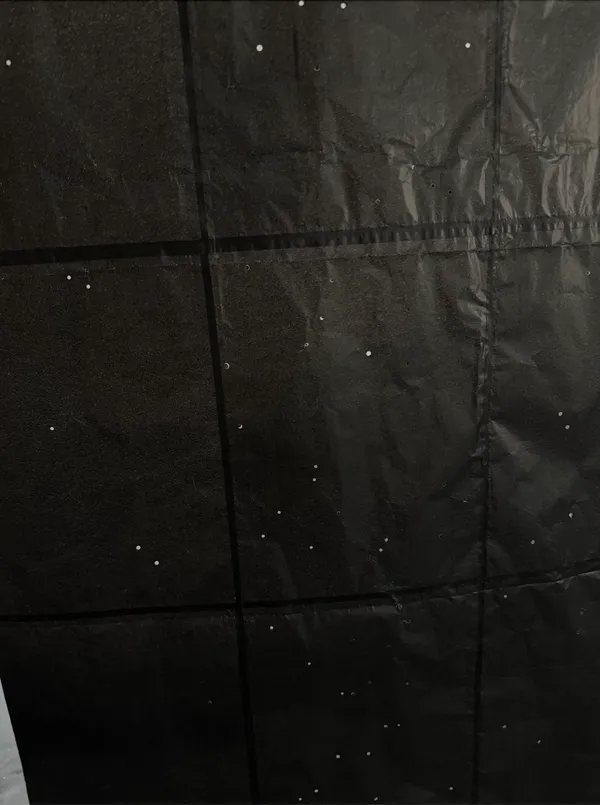
Its physical properties are equally important. It is an extremely lightweight paper that lets light pass through it and moves delicately, reacting even to the slightest movement with a faint sound. It is also very fragile, which makes the installations ephemeral. They only exist for the duration of the exhibition. Over time the material also discolours, gradually fading into a lighter blue.
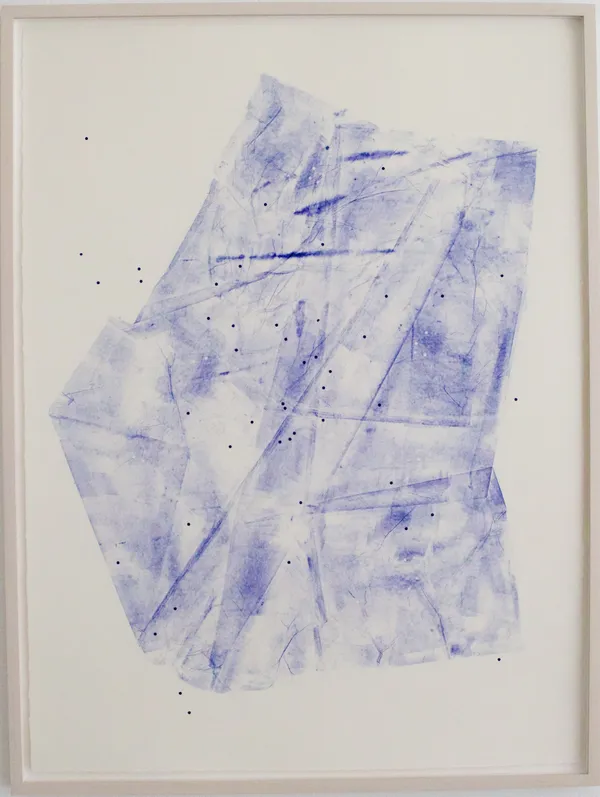
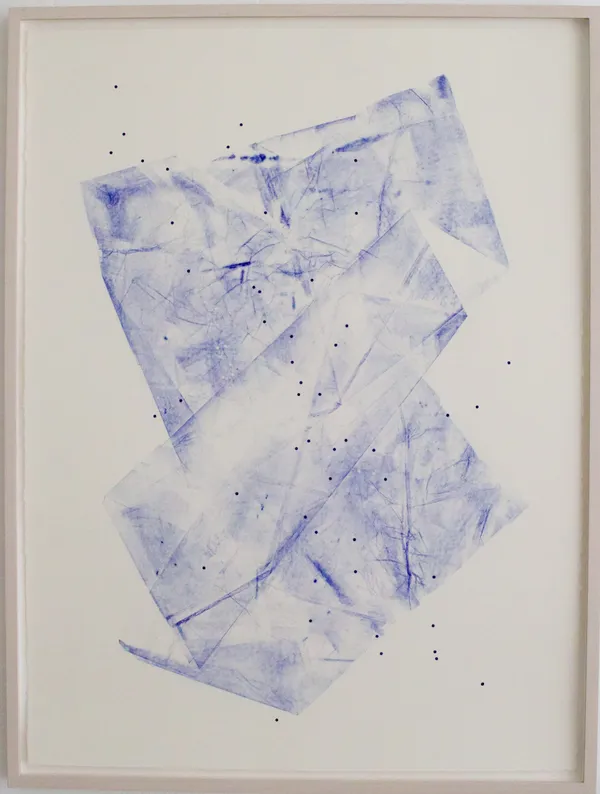
I wanted to find a way to harness these qualities. The result was a series of transfers made from the carbon paper onto high-quality aquarelle paper. The utilitarian carbon, essentially ink, thus becomes a kind of painting. The works are literally “carbon copies”, portraying delicate networks of creases and folds that resemble veins or constellations. The punched text also appears faintly across these prints, like echoes or whispers, though only fragments of the code remain.
The perforations from the carbon paper are then glued onto the surface in a scattered, almost chaotic way. I see these works as small universes of their own and, as the titles suggest, somewhat dreamy.
-
Works on paper
-
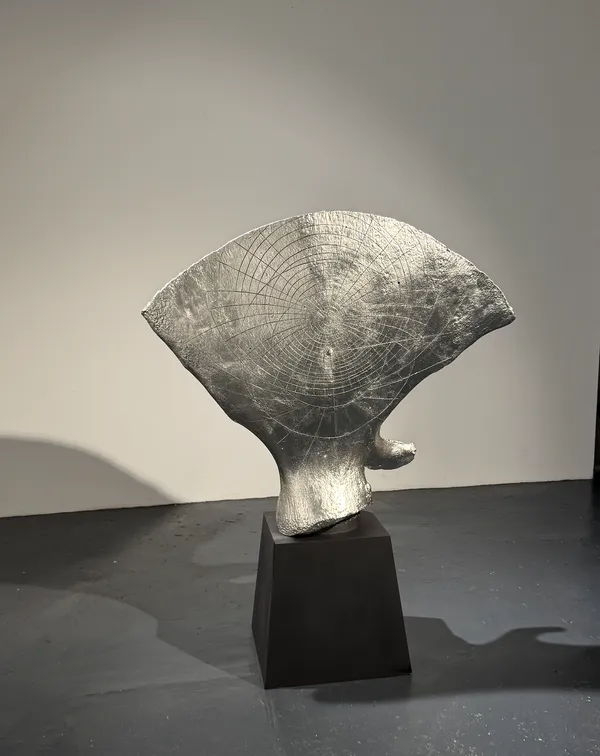
In Träume, the sculptural reconstruction of a whale scapula engraved with astrolabe diagrams connects celestial navigation with an endangered species.
What led you to bring these two systems, astronomical measurement and organic anatomy, together?
AJF: I have long been interested in navigation, both its technological and physical aspects. This includes historical tools, but also its broader ideological connotations, as a way of thinking about our journeys and about navigating challenges related to ecology and geopolitics.
I was inspired by the historical use of whale bones and walrus tusks as surfaces for carving and painting in Iceland and Greenland. In this work I chose to reference bones from vulnerable species in order to reflect the fragility of ecosystems affected by human activity.
The work Cetrolabe is a precise digital rendering of the scapula bone of a North Atlantic right whale, produced at a 1:1 scale. The title echoes both the whale (cetus) and the astrolabe, the historical instrument used for celestial navigation. This particular species is closely connected to Icelandic history and is also one of the most endangered large whale species today. Its dwindling numbers are the result of overhunting, but they are also linked to modern shipping, trade and expansionism.
Engraving the bone with diagrams of navigation and timekeeping creates a kind of paradox. The organic form of the bone does not lend itself to precision and therefore cannot function as an accurate measuring instrument. The tin-surfaced object sits somewhere between tool and artefact, suggesting a ritual object or a speculative instrument rather than a functional one. In this sense the work combines the scientific language of orientation with the anatomy of the whale itself, whose perceived wisdom and remarkable migratory abilities lend the object an added aura
-
Staratlas by Johann Bayer, Uranometria, 1603 & a staratlas by Anna Júlía Fridbjörnsdóttir, 2026
-
The exhibition draws on star atlases, Morse telegraphy, and the nineteenth-century poem Nacht und Träume.
How do these different historical references, astronomy, communication technology and Romantic poetry, intersect within your work?
AJF: I have used communication technologies both as technical elements and as conceptual material in my work, as mentioned earlier. I also use the language belonging to these systems, mainly call signals and their assigned meanings, which I treat as found material. I place them in new contexts where they become both open to interpretation and slightly lyrical.
Morse code, carbon paper and the poem all originate in the early nineteenth century. The poem is typical of the Romantic era, where the symbolism of night suggests transformation and an escape from reality. This Romantic sentiment, partly a response to the Industrial Revolution, can also resonate today in a world undergoing similarly profound and perhaps even more complex changes.
The grid of the star atlas functions as a symbol of mapping and categorisation. I select forms from this imaginary two-dimensional grid and cast them in plaster to create objects with physical weight. Freed from the plan, they are installed to assemble new combinations and connections.
The perforated Morse code in the hanging carbon paper installation becomes partially dissolved. The cut-outs are used again in the wall works in a non-systematic way and begin to resemble stars. One of the plaster casts has holes scattered across its surface and becomes a kind of anti-sound or quiet, titled Stille (Silent).
Many of these systems, astronomy, navigation and communication, were historically tools for orientation. I am interested in how these frameworks still resonate today, even when the systems themselves feel fragile or outdated. By fragmenting and reassembling them materially, the work reflects a moment in which systems of knowledge and orientation are constantly shifting.
In a way the strategies themselves are quite simple. I sometimes describe my way of working by saying that I use effects to create affect.
-
Träume: Centrolab & a staratlas
-
works
-
More on Anna Júlía Fridbjörnsdóttir
-

Anna Júlía Fridbjörnsdóttir
-
Last Season
Anna Júlía Fridbjörnsdóttir Sep 15 - Oct 22, 2022“. . . out there past men’s knowing, where the stars are drowning and whales ferry their vast souls through the black and seamless sea. Cormac McCarthy The work of... -
Nacht & Träume
Anna Júlía Fridbjörnsdóttir Mar 6 - Apr 18, 2026Nacht Anna Júlia Fridbjörnsdóttir Second solo exhibition at Gallery Gudmundsdottir Nacht presents new works that continue Anna Júlia Friöbjörnsdóttir's enquiry into materiality, form and transformation, examining how systems and language... -
Histories of Ecology, MASP Brazil
Anna Júlía FridbjörnsdóttirHistories of Ecology In the same year Brazil hosts COP30, the United Nations Climate Change Conference in Belém, Pará, MASP presents the exhibition Histories of Ecology . This is the...
-
Artist in Focus: Anna Júlía Fridbjörnsdóttir
Current viewing_room